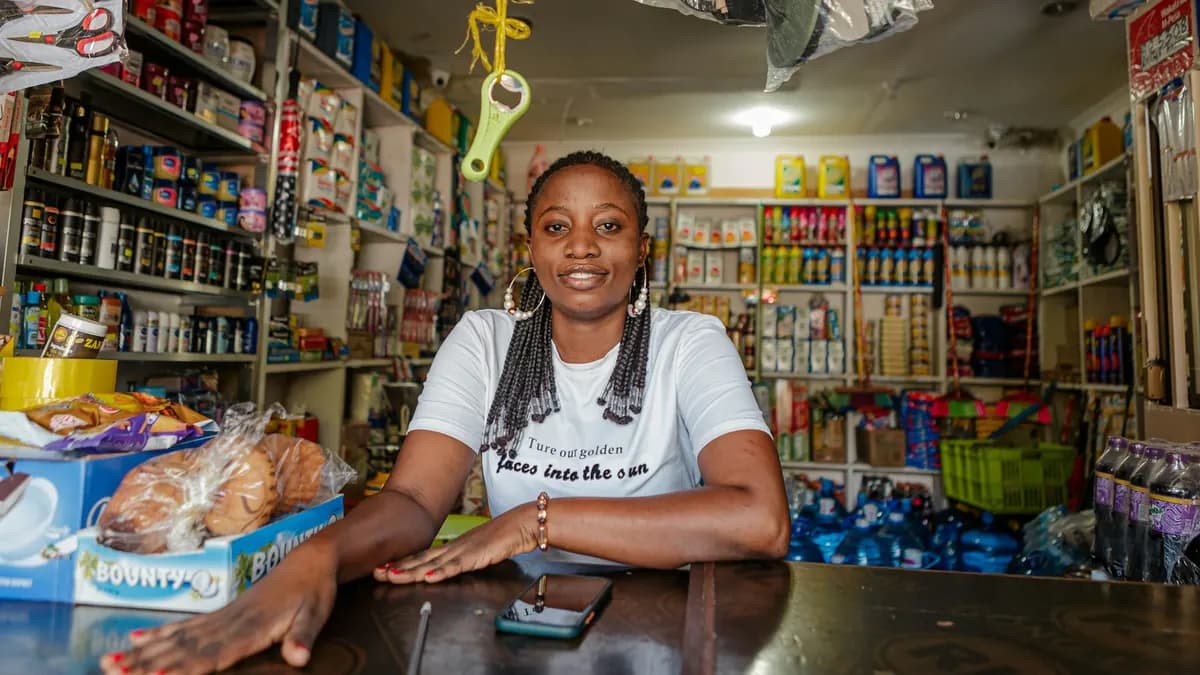
Commercial sustainability is not the enemy of community impact; it is what makes impact last. A spaza shop, a township kitchen or a small service business that runs profitably keeps people employed, buys from nearby suppliers and keeps money moving within its area. One that runs on guesswork, cash in a drawer and missed orders cannot do any of that for long.
This is the thinking behind several of the platforms Lulonke has built, including Ekashop, our township marketplace. This guide looks at the practical technology that helps local businesses grow, and why the way it is built matters as much as what it does.
Why does a profitable local business matter for its community?
Because a profitable local business is a local employer, a customer for other local businesses and a place where money is spent and re-spent nearby. When it grows, it can hire, train people and buy more from suppliers in the same area. When it struggles, that whole chain weakens. Helping local businesses run better is one of the most direct ways to strengthen a community’s economy.
What technology makes the biggest difference for small and township businesses?
The most useful technology for small businesses is rarely complicated. It solves everyday problems: getting paid, taking orders, knowing what is in stock and being found by new customers.
| Need | Practical technology | What it changes |
|---|---|---|
| Getting paid | Card machines, QR-code and mobile payments, instant EFT | Customers without cash can still buy; less cash on the premises |
| Taking orders | WhatsApp Business catalogues, a simple online ordering page | Orders arrive in writing, at any hour, without phone tag |
| Knowing the numbers | A basic sales and stock record, or a point-of-sale app | Owners see what sells, what runs out and what makes money |
| Being found | A Google Business Profile with photos, hours and location | Nearby customers find the business on Google Maps |
| Delivering | Shared delivery networks connected to orders | Reach customers beyond walking distance without owning vehicles |
How do shared platforms help small businesses compete?
Most small businesses cannot afford their own online store, delivery fleet and payment system. A shared platform gives many businesses those tools at once. Ekashop, which Lulonke built and runs, is an example: a multi-sided marketplace that brings spaza shops, township kitchens, liquor outlets and local apparel brands together with delivery drivers and buyers, with inventory, logistics and payments in one system.
The effect is that a corner shop can sell to customers it would never reach on foot traffic alone, a local driver earns from deliveries in their own area, and buyers can support businesses near them as easily as ordering from a large chain. See the Ekashop case study for how the platform is put together.
How does technology help organisations that serve communities?
The same principle applies beyond retail. Membership bodies, unions and workforce programmes serve thousands of people and often run on paper forms and spreadsheets. Putting applications, membership records and communication online makes them faster and more reliable for the people they serve.
- YNITU Connect, which we built for the Young Nurses Indaba Trade Union, handles applications, a member portal and representation workflows around SANC registration requirements. See the YNITU Connect case study.
- Workforce Bridge pairs organisational consulting with a job board, profile matching and interview scheduling, connecting people with work. See the Workforce Bridge case study.
Where should a small business start?
Start with the problem that costs the most time or money every day, and solve that one well before adding anything else. For most small businesses the order is:
- Accept digital payments, so no sale is lost because a customer has no cash.
- Set up WhatsApp Business with a catalogue and quick replies, so orders and questions are handled consistently.
- Keep a simple daily record of sales, stock and expenses, so decisions are based on numbers rather than memory.
- Claim and complete your Google Business Profile, so nearby customers can find you.
- Only then consider a website, online store or marketplace listing, once the basics run smoothly.
Each step is low-cost, and each makes the next one easier. A business that already tracks its stock and takes orders on WhatsApp is ready to sell online; one that does not will struggle however good its website is.
What should local businesses watch out for?
Technology should keep value with the business, not drain it. Before signing up for any platform or system, check:
- The full cost: monthly fees, transaction fees and commission on each sale, added together.
- Who owns the customer list and sales data, and whether you can take it with you.
- How quickly payouts reach your account, because cash flow matters more to a small business than almost anything else.
- Whether it works on the phones and data your business and customers actually use.
- Who helps when something goes wrong, and how quickly.
How Lulonke approaches community-focused technology
We build platforms that are fast on mobile data, simple enough to use without training, and owned by the people who run them. Some, like Ekashop, are Lulonke ventures, where we carry both the build and the commercial result. Others we deliver for organisations that serve their own communities. If you run a business or organisation that could reach more people with the right system, our digital platforms work is where to start.
Frequently asked questions
How can technology help a spaza shop?
The most useful steps are accepting card and mobile payments, taking orders on WhatsApp, keeping a simple record of sales and stock, and listing the shop on Google Maps. Joining a marketplace such as Ekashop adds online orders and delivery without the shop having to build its own systems.
What is the township economy?
The township economy is the network of businesses operating in South Africa’s townships, from spaza shops and kitchens to salons, taverns, mechanics and service providers. Many are small, local employers whose growth directly affects their communities.
Is digital technology expensive for small businesses?
The first steps are usually low-cost: a card machine or mobile payments, WhatsApp Business and a Google Business Profile cost little or nothing to start. Check transaction fees and commissions carefully, because they add up on every sale.
How do small businesses get online without a website?
A complete Google Business Profile and a WhatsApp Business catalogue let customers find you, see what you sell and order, without a website. A marketplace listing adds online ordering and delivery. A website becomes worthwhile once those basics run smoothly.
Does Lulonke build platforms for community organisations?
Yes. Alongside our own ventures such as Ekashop, we have built platforms for organisations such as the Young Nurses Indaba Trade Union and Workforce Bridge. See our work for examples.